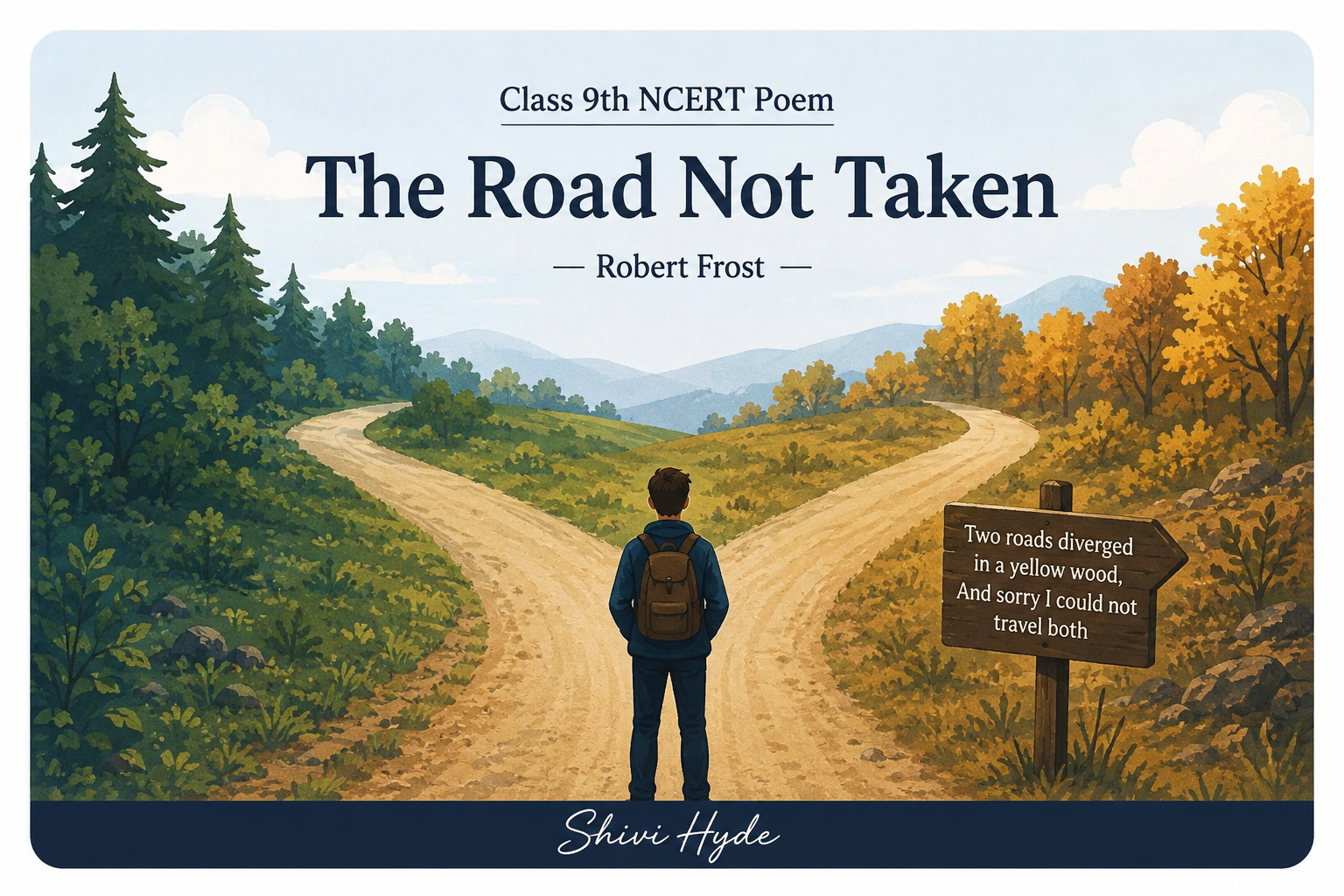
The Road Not Taken by Robert Frost is one of the most popular poems in English literature. It is often taught in schools because its simple story carries a deeper message about choices, decisions, uncertainty, and the consequences of our actions.
The poem describes a traveler who reaches a point where two roads separate in a forest. Since the traveler cannot walk on both roads, he has to choose one. This simple situation becomes a powerful metaphor for the choices people make in life.
If you are looking for an easy-to-understand summary of The Road Not Taken, this guide explains the poem, its central idea, themes, symbolism, and message in simple language.
The Road Not Taken Summary
The poem begins with the speaker walking through a forest during autumn. He suddenly reaches a place where two roads diverge. He feels sorry that he cannot travel on both roads because he is only one person and must choose one.
The speaker stands there for some time, carefully looking at one road to see where it leads. However, he cannot see very far because the road bends and disappears into the trees. This represents the uncertainty people face when making important decisions. We can think carefully about our choices, but we can never completely know what the future will bring.
The speaker finally decides to take the second road. At first, he thinks that it looks slightly less used because it is grassy and seems to need more travelers. However, he soon realizes that both roads are actually almost the same. Both have been covered with fresh leaves, and neither appears to have been significantly more traveled than the other.
After choosing one road, the speaker tells himself that he will return someday and take the other one. But he knows this is unlikely. Once one road leads to another, it becomes difficult to return to exactly the same point.
In the final stanza, the speaker imagines himself looking back on this decision many years later. He imagines saying that he chose the road that was less traveled and that this choice made a great difference in his life.
The ending is deliberately open to interpretation. The speaker may be proud of his decision, but the “sigh” also suggests reflection or even regret. The poem therefore isn’t simply telling readers to always choose the unusual path. Instead, it asks us to think about how we make choices and how we later explain those choices to ourselves.
Stanza-Wise Summary of The Road Not Taken
First Stanza
In the first stanza, the traveler reaches a fork in the road in a yellow forest. He wishes he could travel down both roads, but that is impossible. He studies one road as far as he can, but the road eventually disappears into the forest.
This stanza introduces the main idea of the poem: making a difficult choice when the future is unknown.
Second Stanza
The traveler chooses the other road. Initially, he believes that this road is less traveled because it looks grassy and less worn.
However, he soon admits that the two roads were actually almost equally used. This detail is important because it challenges the common interpretation that the speaker confidently chose a completely different or unconventional path.
Third Stanza
The speaker thinks about the road he did not choose. He tells himself that he will come back one day and explore it.
At the same time, he understands that this probably will not happen. One decision leads to another, making it difficult to return to the exact same situation.
This stanza highlights the irreversibility of life’s choices.
Fourth Stanza
The final stanza jumps into the future. The speaker imagines himself telling the story of his decision years later.
He imagines saying that he took the road less traveled and that the choice made all the difference.
The ending is powerful because it leaves readers wondering whether the speaker truly believes that one road was less traveled or whether he has changed the story in his memory over time.
Themes of The Road Not Taken
1. Choices and Decisions
The most important theme is the difficulty of making choices. Just like the traveler has to choose between two roads, people regularly face decisions that can change the direction of their lives.
2. Uncertainty
The traveler cannot see where either road will lead. This represents the uncertainty of the future. We often have to make important decisions without knowing exactly what will happen afterward.
3. Regret and Reflection
The speaker thinks about the road he did not take. This reflects a common human tendency to wonder about the alternatives we leave behind.
4. Individuality
The poem is often associated with choosing an independent or unusual path. However, the poem itself complicates this interpretation because the two roads are described as being almost equally worn.
Symbolism in The Road Not Taken
The two roads are the most important symbols in the poem. They represent different choices or directions in life.
The yellow wood suggests autumn, a season associated with change and transition.
The fork in the road represents a moment when a person must make an important decision.
The road not taken represents the possibilities we leave behind whenever we make a choice. Once we choose one direction, we may never know what would have happened if we had chosen the other.
Message of The Road Not Taken
The main message of the poem is that choices are an unavoidable part of life. We cannot experience every possibility, so choosing one path automatically means leaving another behind.
Frost also reminds us that we cannot always predict the results of our decisions. Sometimes, we only understand the importance of a choice when we look back on it years later.
Most importantly, the poem encourages readers to think deeply about how people remember and interpret their past decisions.
Conclusion
The Road Not Taken summary can be understood as the story of a traveler facing two paths and having to choose one. But beneath this simple story is a deeper reflection on human life.
Robert Frost shows that decisions are rarely as straightforward as they seem. We may carefully consider our options, but we can never know exactly where each choice will lead. Once we choose, the alternative becomes a part of our imagination.
That is what makes The Road Not Taken so relatable. Everyone reaches their own “forks in the road,” and everyone eventually looks back and wonders what might have happened if they had chosen differently.
FAQs About The Road Not Taken
1. What is the main idea of The Road Not Taken?
The main idea of The Road Not Taken is the difficulty of making choices and dealing with the uncertainty that follows them. The two roads represent different choices in life.
2. What do the two roads symbolize?
The two roads symbolize the different choices and opportunities people encounter in life. Choosing one road means giving up the opportunity to experience the other.
3. Why is the poem called The Road Not Taken?
The title focuses attention on the road the speaker leaves behind. It represents the choices and possibilities that people do not pursue and may later wonder about.
4. What is the message of The Road Not Taken?
The poem suggests that choices are unavoidable and that we cannot know their consequences beforehand. It also explores how people may reinterpret their decisions when looking back at their lives.
5. Is The Road Not Taken about choosing the less-traveled path?
Not exactly. Although the final stanza mentions the “less traveled” road, earlier in the poem the speaker admits that the two roads were actually about equally worn. This makes the poem more complicated than a simple message about always choosing an unconventional path.