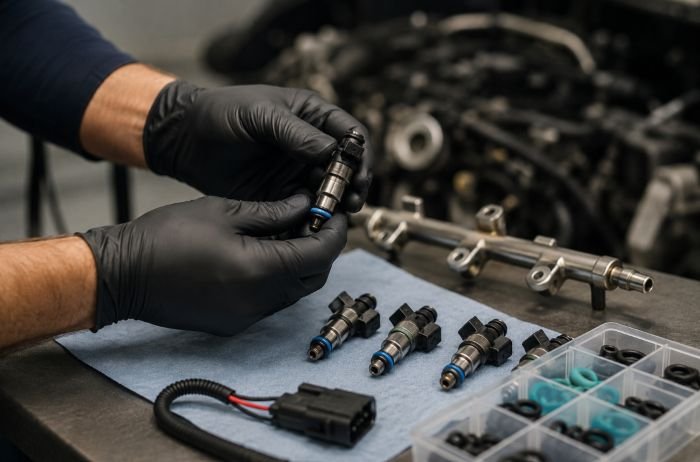
Ask any rebuilder about the job that taught them the most, and the story usually involves fuel delivery. A freshly machined block, new bearings, a careful break-in, and then a stubborn misfire that no amount of tuning could chase away. The culprit, more often than people expect, is a set of injectors that were never tested as a group. Fuel system components look interchangeable on a shelf, but the difference between a matched set and a random assortment shows up the first time the engine idles.
Tolerance Stacking Ruins Good Rebuilds
Every injector drifts a little from its rated flow. One unit runs 2 percent rich, another 3 percent lean, and individually neither would raise a concern. Put them on the same rail, though, and the engine now feeds its cylinders unevenly. The computer trims fuel based on an averaged oxygen reading, so it can never fully correct a single cylinder.
Over thousands of miles this imbalance wears one piston faster, fouls one plug sooner, and makes an otherwise solid rebuild feel worn out. Bench flow testing catches these issues before installation, which is why experienced builders insist on it.
The Case for Remanufactured Originals
Factory injectors from Bosch, Denso, and Siemens Deka were engineered for specific engines and built to tolerances that generic copies rarely hit. Remanufacturing keeps that original hardware in service. The process strips each unit down, ultrasonically cleans the internals, replaces filters, O-rings, and pintle caps, then verifies spray pattern and flow rate on a bench.
Independent industrial suppliers handle much of this work in the United States, including small direct-to-customer shops in rural New Hampshire that serve mechanics, marinas, and DIY builders nationwide. Cutting out distributor layers keeps the price close to generic alternatives while the quality stays at factory level.
Supporting Hardware Matters More Than It Looks
A perfect injector still leaks through a hardened O-ring or loses signal through a corroded pigtail. Seasoned buyers order the small parts in the same cart:
- Rebuild kits matched to the exact injector family
- Connector pigtails for brittle factory wiring
- Rail clips and spacers that keep everything seated under vibration
Suppliers who stock these alongside the injectors themselves, covering everything from Powerstroke diesels to Mercury and Sea-Doo marine engines, tend to be the ones who understand fuel systems rather than simply reselling boxes.
Sourcing Decides the Outcome
Engine builders can control machining, assembly, and tuning, but vendors decide fuel metering quality before the parts arrive. That places real weight on the vendor, since no amount of skill at the bench can fix an injector that left the warehouse out of spec.
Thousands of verified reviews, published flow data, and a willingness to answer fitment questions signal a supplier that treats these components as precision instruments. Anyone comparing options for a restoration, a turbo upgrade, or routine maintenance will find that dedicated catalogs of flow-matched Automotive Injectors make the search considerably shorter.
The engine only knows what it is fed, and it repays careful sourcing with years of smooth, predictable running.