Lending is one of those businesses everyone uses and few people think about. You swipe an EMI card for a phone, take a car loan, or borrow against your home, and somewhere a non-banking finance company (NBFC) is quietly earning the spread. For investors, two names come up again and again in this space: Tata Capital and Bajaj Finance.
If you are tracking the Tata Capital share price or the Bajaj Finance share, this guide will help you understand what you are really looking at. We will cover how each company makes money, what pushes the stock up or down, and the checks worth doing before you invest.
A newcomer and an established name
The first thing to know is that these two are at very different stages of their listed journey.
Tata Capital made its stock market debut on 13 October 2025, listing at ₹330 on both NSE and BSE, a small premium over the top of its IPO price band. The public issue raised ₹15,511.87 crore through a mix of fresh shares and an offer for sale. That makes it a relatively new listing, so its trading history is short. Investors who like to study how a stock has behaved across several market cycles have less to work with here.
Bajaj Finance, on the other hand, has been a listed company for many years and is part of the Bajaj Finserv group. It is widely regarded as one of the country’s largest and most closely followed NBFCs, and analysts have had a long time to study how it performs through good and bad credit cycles.
Neither fact makes one stock better. It just means the kind of evidence available to you is different.
How Tata Capital makes money
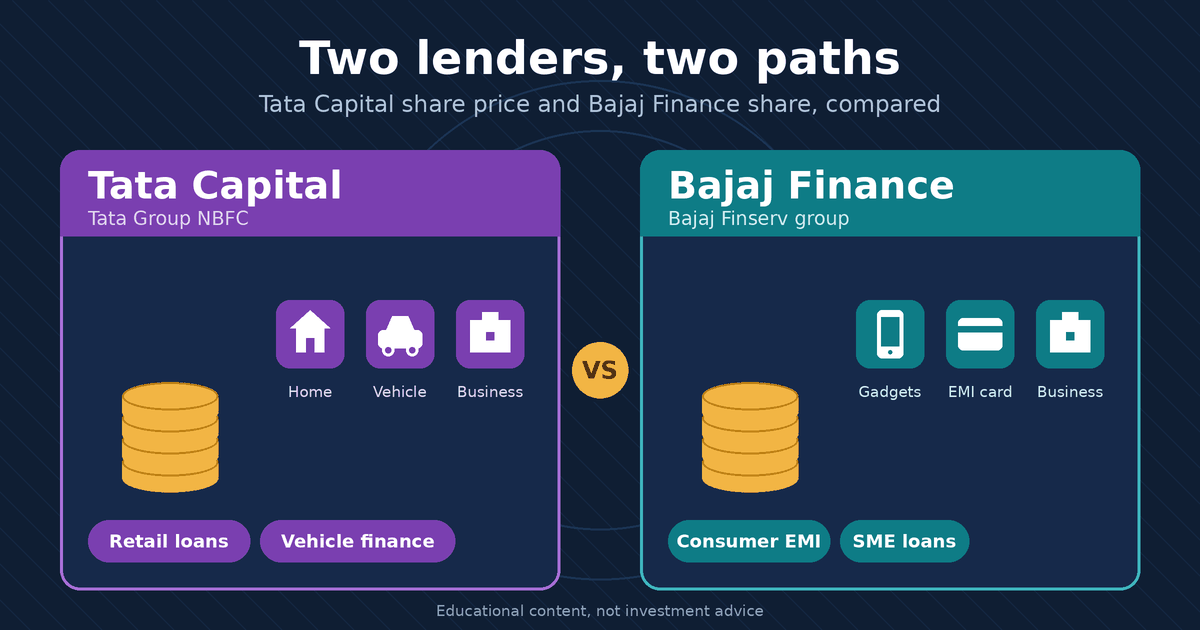
Tata Capital is the flagship NBFC and financial services arm of the Tata Group, operating under Tata Sons. It lends across several categories, including home loans, car loans and business loans, and also has wealth and other financial services alongside. Retail finance made up a majority of its gross loans at the time of its IPO documents, reflecting a consumer-focused approach. It has also been combining its vehicle finance operations with Tata Motors Finance, which strengthens its position in that segment.
The brand does a lot of quiet work here. Borrowers and lenders alike tend to trust the Tata name, and that can help with funding costs. Lower funding costs matter enormously for a lender, because the gap between what it pays to borrow and what it earns by lending is the core of its profit.
How Bajaj Finance makes money
Bajaj Finance built its reputation on consumer lending: financing for electronics and appliances through EMI options, personal loans, and loans for small businesses and professionals. It also offers loans against property, gold loans, and fixed deposits, and runs a large digital platform for customers.
Its strength has traditionally been speed and scale. It reaches a very large customer base, cross-sells aggressively, and has leaned on data and technology to make lending decisions. The flip side is that a lot of its book sits in unsecured or lightly secured lending, which can be more sensitive when the economy slows or borrowers come under pressure.
What moves these stocks
Because both companies are lenders, they respond to a similar set of forces.
Interest rates. When rates rise, borrowing costs for the company go up. If it cannot pass that on quickly, margins shrink. When rates fall, the reverse can happen.
Asset quality. This is the share of loans that borrowers fail to repay. Rising bad loans mean higher provisions and lower profit. Investors watch gross and net NPA figures very closely every quarter.
Loan growth. Healthy demand for credit boosts earnings. A slowdown in consumer spending or business activity shows up fast in the numbers.
Regulation. The Reserve Bank of India sets rules on risk weights, lending norms, and how NBFCs are supervised. A change in policy can shift a stock overnight.
Capital strength. Lenders need enough capital to keep growing. A strong capital buffer gives a company room to expand and absorb shocks.
Side by side
| Tata Capital | Bajaj Finance | |
|---|---|---|
| Group | Tata Group | Bajaj Finserv group |
| Listing | Listed October 2025 | Long-listed, established track record |
| Focus | Diversified lending, strong retail and vehicle finance | Consumer, SME and wide product mix |
| Main appeal | Brand trust, diversified book | Scale, growth record, digital reach |
| Main watch point | Short listed history, integration of merged units | Exposure to unsecured lending, high expectations |
Use this as a rough guide, not a verdict.
How to read the price properly
A share price is only a number. What matters is what you get for it. Before you decide, look at these figures on a reliable platform:
- Price-to-earnings (P/E): how much you pay per rupee of profit. A high P/E means the market expects strong growth, and any disappointment can hurt.
- Price-to-book (P/B): especially useful for lenders, since their balance sheets drive their value.
- Return on equity (ROE) and return on assets (ROA): how well the company turns capital into profit.
- Gross and net NPA: the health of the loan book.
- Net interest margin: the spread between lending and borrowing costs.
- Capital adequacy: whether the company has enough buffer to grow safely.
Do not compare the two companies’ share prices directly, either. A higher price per share does not mean a more valuable company. Compare valuations and quality instead.
Common mistakes to avoid
Chasing a famous name. A trusted brand reduces some risks, but it does not guarantee returns. Valuation still matters.
Judging a new listing too early. With a short trading history, it is easy to read too much into a few weeks of price moves.
Ignoring the credit cycle. Lenders can look brilliant when borrowers are repaying on time and shaky when they are not. Ask how each company performed during tougher periods.
Putting too much in one sector. Banks and NBFCs tend to move together when interest rates or regulation shift. If your portfolio already leans heavily on financials, think about balance.
Which one fits you?
If you value a long track record, a proven growth engine, and a business you can study across many years, Bajaj Finance gives you more history to analyse. Just be realistic about the expectations already built into the price.
If you like the idea of a diversified lender backed by a respected group and are comfortable with a newer listing, Tata Capital may interest you. Give it time to build a record, and pay attention to how its recent mergers settle in.
Some investors hold both to spread risk across different lending styles. That is a personal call that depends on your goals, time horizon, and tolerance for volatility.
Final thoughts
The Tata Capital share price and the Bajaj Finance share offer two different routes into India’s lending story. One brings a new listing with a strong parent. The other brings years of data and a reputation for growth. Understanding what each one earns from, and what could go wrong, will serve you far better than watching daily price swings.
Read the latest quarterly results, compare valuation and loan quality, and invest in line with your own plan.
Disclaimer: This article is for educational purposes only and is not investment advice. Investments in the securities market are subject to market risks. Please read all related documents carefully and consult a SEBI-registered advisor before investing.