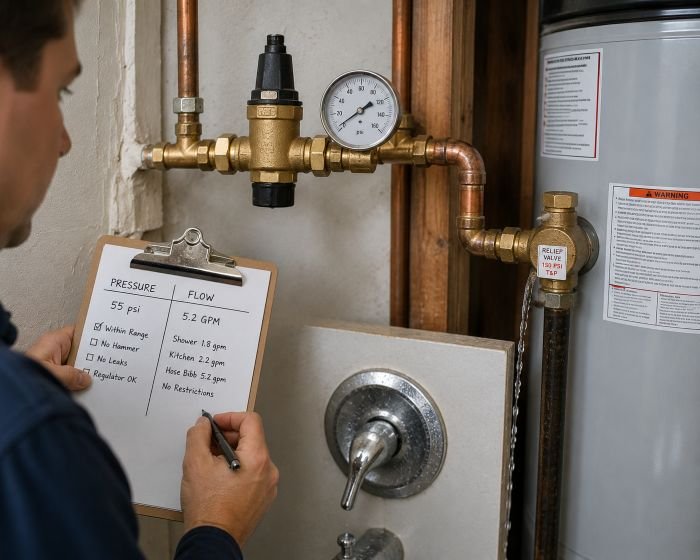
Homeowners tend to use the two terms interchangeably, and plumbers spend a fair amount of time untangling them. Pressure is force, measured in psi, and it exists in the pipe whether or not a tap is open. Flow is volume over time, measured in gallons per minute, and it only exists once water moves. A house in Vista can post a perfectly healthy 55 psi at the hose bib and still deliver a disappointing shower, because the restriction sits somewhere between the gauge and the fixture.
Sorting out which number is off changes the repair entirely. One points toward the service line and the regulator. The other points toward pipe interiors, valves, and fixture hardware.
Symptoms That Belong to Pressure
Force problems announce themselves through noise and premature failure rather than weak output:
- Knocking or hammering in the walls after a valve closes quickly
- Toilet fill valves and faucet cartridges that need replacing every year or two
- A water heater relief valve that weeps with no temperature fault
- Supply line connections that seep at the threads
Anything above 80 psi sits outside what California code allows at the fixture, and North County service lines frequently deliver more than that because the system has to serve properties higher on the grade.
Symptoms That Belong to Flow
Volume problems behave differently. The house stays quiet, nothing fails early, and the water simply arrives slowly. Older galvanized supply lines are the usual culprit in mid century Vista homes, since corrosion builds inward and narrows the passage a little more each year. Mineral scale does the same thing to aerators, cartridges, and shower heads across a region with hard water.
Technicians providing Professional Water Pressure Services in Vista, CA usually separate the two by gauging at the service entry, then measuring output at individual fixtures. A strong reading upstream paired with poor delivery downstream isolates the problem to a specific run of pipe rather than the supply itself.
The Regulator Sits Between Both
A pressure reducing valve is the one component that can produce either symptom set. Most last somewhere between ten and fifteen years, and the failure mode is unpredictable. A valve that fails open passes street pressure straight through to the fixtures. A valve that fails closed strangles the whole house, which reads like a flow problem even though nothing inside the walls has changed.
Homes with a regulator also run as closed systems, so heated water cannot expand back toward the main. That is the purpose of an expansion tank, and a waterlogged one lets pressure spike every heating cycle without any outward sign.
A Reasonable Testing Habit
A hose bib gauge costs less than a restaurant meal and gives a reading in seconds. Taking one in the morning and another late at night is more informative than a single check, since municipal pressure tends to rise overnight as demand drops. A reading that has climbed noticeably since the last test is worth acting on before a supply line decides the matter first.