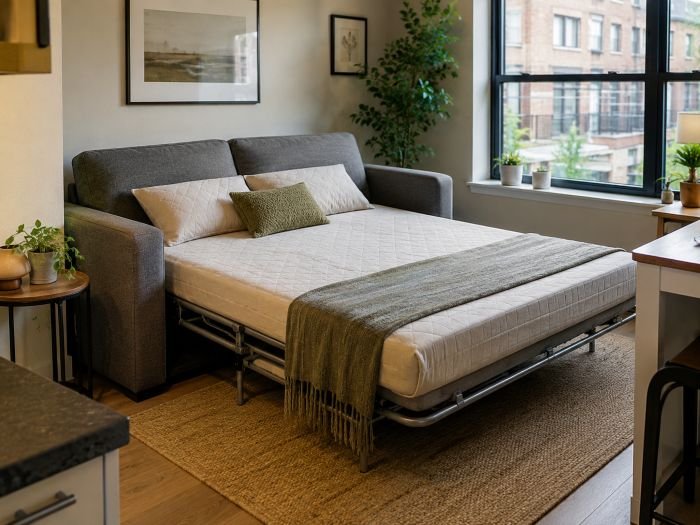
Ask a furniture salesperson what changed most in living room seating over the past decade and the answer is rarely a color or a silhouette. It is the number of households buying one piece to cover two functions. Rising rents, smaller floor plans, and the disappearance of the dedicated guest room have pushed convertible seating from a last resort into a first choice.
That shift raised expectations. A convertible bought today is judged as a sofa first, a bed second, and a long-term purchase in both roles.
Frequency of Use Sets the Spec
The right build depends almost entirely on how often the piece converts. A sofa in a home office that hosts relatives twice a year has different demands than a studio apartment piece that folds out every single night.
Occasional use tolerates a simpler mechanism. Nightly use does not. Daily conversion puts stress on the hinges, the frame joints, and the seat cushions, and any weakness in those three areas shows up within months. Treated hinge hardware, solid wood or steel framing, and high density foam are the difference between a piece that lasts eight years and one that starts sagging before the second winter.
Corner Rooms Change the Math
Sectionals with a sleeper function solve a problem straight sofas cannot. They fill a corner that would otherwise sit empty, add seating without adding a second piece of furniture, and often include storage in the chaise. The tradeoff is placement flexibility, since a sectional commits to a layout in a way a standard three seater does not.
A few things worth confirming before committing to a sectional layout:
- Whether the chaise orientation is reversible, which matters for future moves
- Total wall length required, including any clearance for the bed extension
- Storage access, since some designs require lifting the seat cushions off entirely
Shoppers comparing Small Sofa Beds against compact sectionals often find the decision comes down to the shape of the room rather than the number of people being seated.
Materials Age in Public
Upholstery is the part of a sofa that shows wear first, and it is also the part most people choose based on a photograph. Performance fabrics rated for heavy use handle daily traffic, pets, and the friction of repeated conversion far better than untreated woven options. Foam behaves the same way. High density foam and individually wrapped pocket springs recover their shape after being compressed, while low density fill flattens and stays flat.
None of this is visible at the point of purchase, which is exactly why construction specs deserve more attention than styling does.
Pieces That Move Well
Compact convertibles tend to outlive the apartments they were bought for. Clean lines, tapered legs, and neutral upholstery adapt to the next floor plan without looking out of place, while trend heavy shapes rarely make the move gracefully.
Furniture that covers two roles is not a compromise anymore. It is the standard answer for rooms that were never going to be single purpose in the first place.