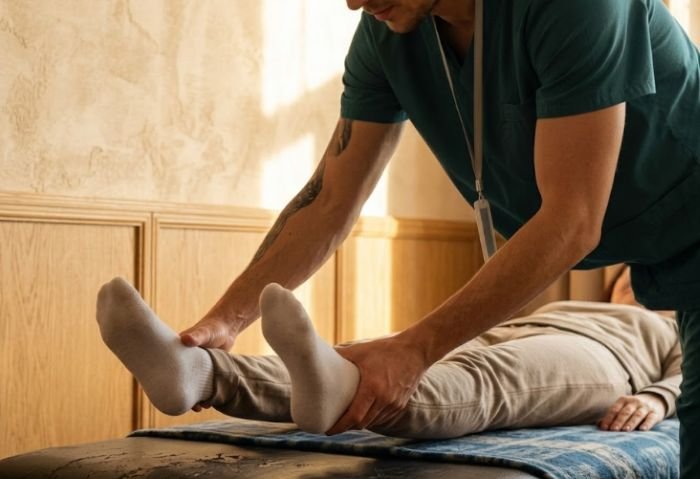
Most people trace back pain to a mattress, a desk chair, or a heavy bag. Few think to look down at their feet. Yet the feet act as the foundation of the entire skeletal structure, and small imbalances there often travel upward, quietly reshaping posture, gait, and spinal alignment over time.
How Feet Influence Spinal Alignment
The body doesn’t work in isolated pieces. It works more like a chain, where each link affects the next. When the arches of the feet collapse or roll unevenly, the ankles, knees, hips, and lower back all pitch in to keep a person steady while they walk or stand. That constant compensating can tilt the pelvis out of level, and the spine responds by curving slightly just to hold everything upright.
Given enough time, usually months or years, this pattern starts to show up as:
- Joints wearing unevenly, especially in the knees and hips
- Persistent tightness through the lower back and hamstrings
- Shoulder or neck strain that keeps returning after postural shifts
- Getting tired faster than expected during standing or walking
None of this happens suddenly. It builds slowly in the background, which is precisely why so many people never connect their foot function to what’s going on in their spine.
Signs the Body Sends Before Pain Begins
Discomfort is usually a late warning sign, not an early one. Before pain sets in, the body typically sends subtler signals. Uneven shoe sole wear, a slight limp after long walks, or one hip feeling higher than the other are common early indicators. Some people notice their shoes feel different on each foot or that standing for extended periods becomes tiring faster than it used to.
A licensed chiropractor is trained to evaluate gait, posture, and spinal curvature together, rather than treating each complaint in isolation. This full-picture approach often reveals that a foot issue has been quietly influencing pain elsewhere in the body.
Support That Works With the Whole Body
Addressing the root cause sometimes means looking beyond the spine itself. For patients whose foot mechanics are contributing to postural strain, providers may recommend properly fitted support tailored to the individual’s foot shape and gait pattern. Those exploring Custom Orthotics In New York City often find that pairing this support with regular chiropractic care creates a more complete, lasting approach to correcting alignment rather than masking discomfort temporarily.
This combined method reflects a broader shift in musculoskeletal care, where practitioners look at how each structure in the body affects the next, instead of isolating symptoms.
Why Professional Evaluation Matters
Self-diagnosing posture problems rarely works well, since compensations are often invisible to the person experiencing them. An experienced chiropractor, especially one with decades of clinical observation, can conduct a thorough evaluation that identifies patterns often overlooked in a general checkup. Clinics that combine chiropractic assessment with attentive, individualized care tend to catch these connections earlier, helping patients avoid years of unnecessary strain.
Understanding the relationship between the feet and the spine is not about chasing a trend. It is about recognizing that the body rarely sends pain from just one place and that lasting relief often begins at the ground level.