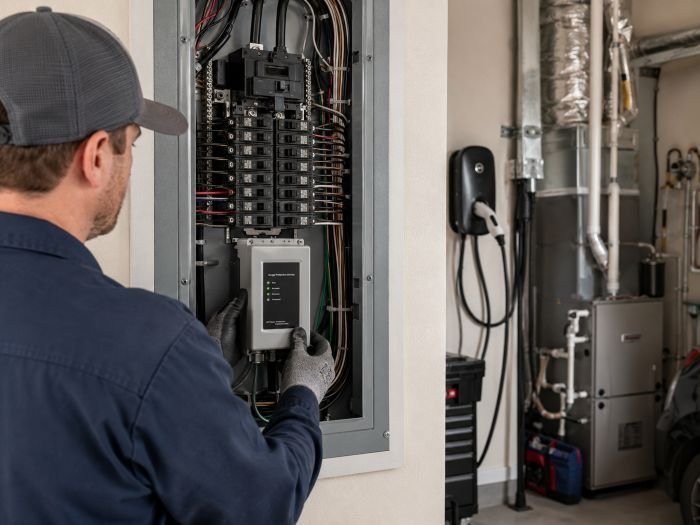
A direct lightning hit makes for a memorable story, and it is also among the least likely ways a household loses its electronics. Claim records and utility power quality studies point somewhere else entirely. The events that retire a furnace control board or a refrigerator inverter early are far smaller, far more frequent, and almost never noticed while they occur.
Damage Accumulates Instead of Announcing Itself
Appliances built in the past fifteen years run on circuit boards designed for tight voltage tolerances. A 120 volt circuit that climbs to 400 volts for a few microseconds will not trip a breaker, because breakers respond to current over time rather than to voltage peaks. The board absorbs the energy. Nothing looks wrong afterward. Several hundred events later, a component gives out and the appliance gets replaced years ahead of its expected service life.
Households along the Wasatch Front see these spikes from routine sources:
- Air conditioning compressors and furnace blowers cycling on
- Utility switching and capacitor bank operations on the distribution grid
- Vehicle chargers and shop tools sharing a service with everything else
- Tree limbs contacting overhead lines during wind and heavy snow
Protection Belongs Upstream of the Receptacle
A plug-in strip guards only what is plugged into it. That leaves out every hardwired load in a house: the furnace, the air handler, the dishwasher, the garage door opener, recessed lighting drivers, and the panel busbar itself. A Type 2 surge protective device installed at the service equipment covers the entire distribution system at one point, with plug-in units left to handle computers and entertainment gear as a second layer. Homeowners pricing out Residential Whole House Surge Protector Installation in Salt Lake City often pair the work with a panel inspection, since both require the same shutdown and the same access.
Grounding Determines Whether Any of It Functions
Surge devices do not eliminate energy. They divert it to ground, which means the grounding and bonding system carries the entire burden of the design. Salt Lake City has a large inventory of houses wired well before grounded receptacles were standard, and plenty of those services have had a modern panel bolted onto an aging grounding electrode arrangement. A corroded ground clamp or an undersized conductor turns an otherwise capable device into decoration. Any competent evaluation begins there rather than with product selection.
Service Life Runs Out Silently
The metal oxide varistors inside these units wear down as they absorb energy, and the unit stops protecting once they do. Most models carry a status light or an audible alarm, though a panel tucked into a basement corner rarely gets a second glance. Adding the check to a seasonal maintenance routine costs nothing.
Manufacturer warranties on connected equipment usually carry conditions worth reading in advance. Many require installation by a licensed electrician, a permit on file, and documentation of the completed work. Skipping those steps tends to void the coverage that motivated the purchase in the first place.