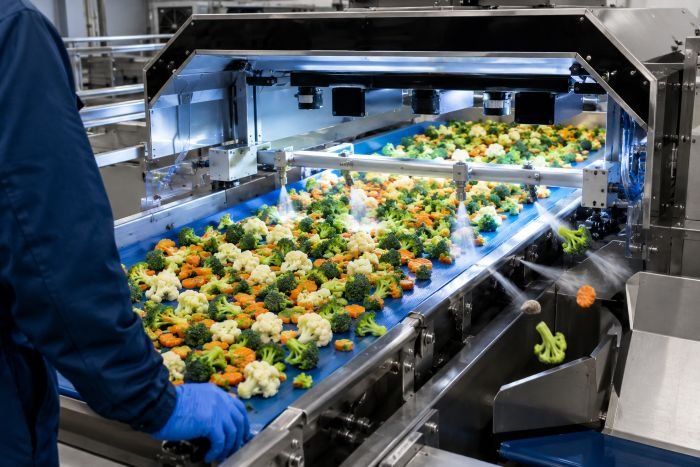
A single pebble or a stray piece of stem can halt a production run and, in the worst case, reach a customer. Food plants guard against that with layers of automated inspection and material handling that examine products far faster and more consistently than a manual crew ever could. The result is a steadier flow of safe, uniform product from the receiving dock to the packaging line.
Finding What Should Not Be There
Foreign material removal is the first job most inspection systems are asked to do. Cameras and sensors scan for anything that differs from the product itself, whether that is a rock, a shell fragment, a splinter of wood, or plant debris carried in from the field. Air ejectors then blow the offending item off the stream, usually without slowing the line, and the same pass can pull out product that has spoiled or been damaged before it ever reaches a person’s plate. This work pays off in two directions at once. It protects the person eating the product, and it protects the processor from the cost and reputation damage of a recall.
Grading for a Consistent Pack
Alongside safety, inspection systems sort by quality so that what ends up in a bag looks and tastes the same batch after batch. Graders read color, size, and shape, then route product into streams that match different customer specifications.
- Off-color or bruised pieces are diverted rather than packed
- Undersized items can be sent to a secondary line instead of discarded
- Prime product is held to the tightest grade for premium packs
Handling That Protects Yield
Every drop, jam, or rough transfer costs product, and lost product is lost margin. Conveying equipment is built to move food gently and evenly, spreading it into a single layer so sorters can read it clearly and so fragile items do not crack or bruise on the way through. Steady, well-paced movement also keeps the line from bottlenecking, which lets the inspection stages run at full capacity instead of waiting on backed-up product.
The Value of One Connected Line
Inspection and conveying deliver the most when they are engineered to work together rather than bolted on piece by piece. Food Sorting Machines and Processing Conveyors that share data and timing let a plant react to a quality shift in real time instead of after a batch is already boxed. Suppliers such as Key Technology design sorting, grading, and conveying equipment as an integrated set, an approach that tends to raise yield and trim the labor spent on manual sorting.
For the shopper, none of this is visible. The payoff shows up in small ways: a bag of peas without stems, chips of even color, and produce that arrives whole. Behind that ordinary consistency sits a line of machines doing careful work at a pace no human hand can match, checking every piece the same way at the end of a shift as it did at the start.