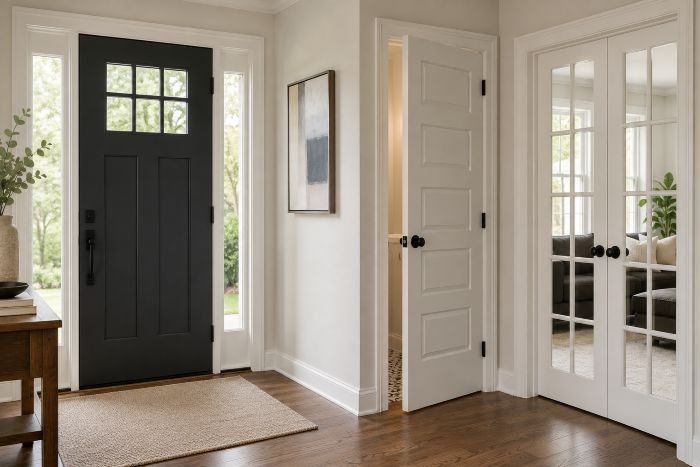
Most renovation budgets get spent on the things people photograph. Countertops, backsplashes, flooring. Doors tend to sit at the bottom of the list, which is strange, because a house has more doors than counters and every single one gets touched daily. A sticking door or a hollow slab with a dent in it does more damage to how a home feels than a dated tile ever will.
Exterior Doors Carry the Heaviest Workload
An entry door handles weather, security, insulation, and first impressions all at once. It also fails quietly. Warped frames let in drafts that show up on utility bills months before anyone notices the gap. Weatherstripping flattens out. Original hardware loosens until the deadbolt no longer seats cleanly.
Fiberglass has become the default recommendation for climates with real temperature swings, since it resists warping and holds paint longer than wood. Steel doors offer strong security and low cost but dent under impact and can transfer heat. Solid wood still wins on appearance and can be refinished repeatedly, though it demands maintenance that many homeowners underestimate.
Anyone browsing Doors for sale will notice the price spread between these materials is wide, and the gap usually reflects core construction rather than the visible surface.
Interior Doors Set the Tone Room by Room
Interior doors get judged differently. Sound matters more than insulation, and weight matters more than security. Hollow core doors are light, cheap, and easy to hang, which is why builders install them by the hundreds. They also transmit noise from one room to the next and feel flimsy in the hand.
Solid core doors cost more and require sturdier hinges, but the difference is immediately noticeable:
- Conversations stay contained in home offices and bedrooms
- The door closes with weight instead of a rattle
- Dents and punctures become far less likely in high traffic hallways
Style choices matter less than most people expect. Two panel and five panel designs have stayed in circulation for decades because they read as neutral rather than trendy.
Material and Finish Decisions Worth Slowing Down For
Prefinished doors save labor but limit color choices. Primed doors require painting on site, which adds a day or two but allows exact matching to existing trim. Barn style hardware has stayed popular in open floor plans where a swinging door would block traffic, though it provides almost no sound isolation.
Glass inserts change a room’s light entirely. A single frosted panel in an interior door can pull daylight into a windowless hallway without sacrificing privacy.
Measurements Come Before Anything Else
Standard interior openings in American homes usually run 30 or 32 inches wide by 80 inches tall, but older houses rarely follow standards. Rough opening width, jamb depth, and hinge placement all need confirming before a purchase. Swing direction gets recorded wrong more often than any other measurement, so checking which side the hinges sit on while standing outside the room is a habit worth keeping.
Replacing doors is one of the few upgrades that improves comfort, noise, energy use, and appearance at the same time. That combination is rare in home improvement, and it usually costs less than the projects competing for attention.